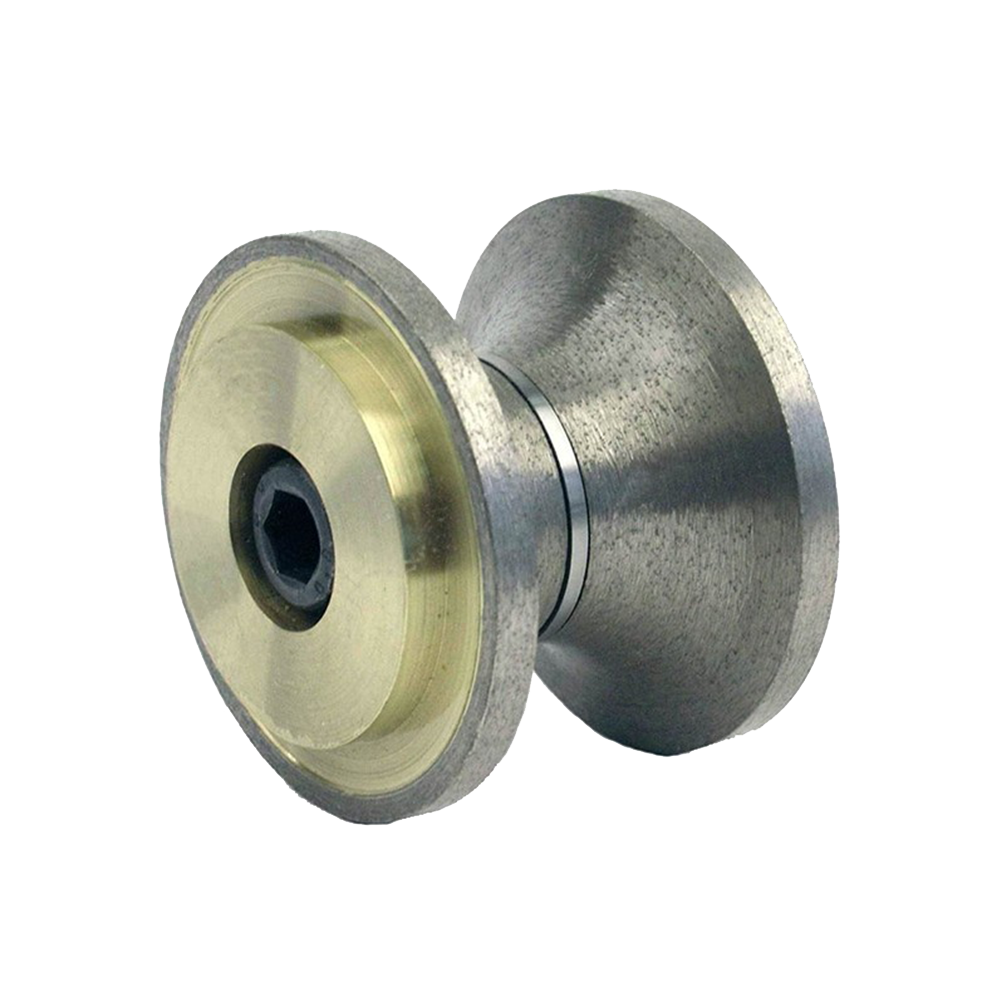
What Vacuum Brazing Actually Changes
Three things happen in the furnace that you feel on the machine:
- Chemical bond, not mechanical grip. The braze alloy wets and bonds to the diamond surface, so crystals are held far more firmly than in electroplating and do not pull out prematurely.
- Diamond survives the process. Unlike sintering — where high temperature and pressure can convert diamond to graphite — controlled vacuum brazing preserves crystal integrity, so you start with full-strength diamond.
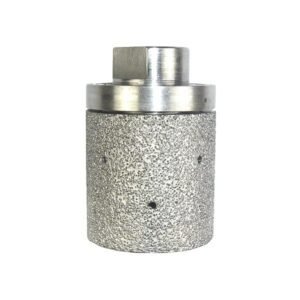
- High exposure = high aggression. With ~70% of each crystal exposed, the bit slices instead of rubbing. It cuts faster, generates less heat, and needs less feed pressure — which is also what keeps edges chip-free.
One trade-off to be aware of: a vacuum brazed bit is single-layer. Once the exposed diamond is consumed the bit is finished — it is replaced, not dressed. That is the price of cutting this fast.
Full Specifications
| Product | Vacuum Brazed Diamond Router Bits (finger bits & profile bits) |
|---|---|
| Manufacturing process | Vacuum brazing (furnace brazed in vacuum) |
| Abrasive | Synthetic monocrystalline diamond |
| Diamond grit | #30/40 (standard), #40/50, #60, #80, #100, #120 |
| Grit class | Coarse #30/40–50 / Medium #60–80 / Fine #100–120 |
| Diameter | 10, 16, 18, 20, 25, 50, 75 mm (custom available) |
| Working length | 20, 30, 40, 50, 60 mm (custom available) |
| Working thickness (profile) | 35 mm |
| Shank / connection | M14, 5/8″-11, 1/2″ Gas (BSP), straight shank 6 / 8 / 10 / 12 mm, 1/4″, 1/2″ |
| Body material | Hardened 45# / alloy steel |
| Diamond exposure | ≈70% (single layer) |
| Water feed | Center water-feed hole (finger bits) |
| Working condition | Wet recommended; short dry passes acceptable |
| Max speed (Ø10–20 mm) | up to 12,000 rpm |
| Max speed (Ø25 / Ø50 / Ø75 mm) | 10,000 / 8,000 / 6,000 rpm |
| Machine | CNC stone router, radial arm machine, angle grinder, hand-held grinder, engraving machine |
| Applications | Edge profiling, sink cutouts, hole grinding, anchor & blind holes, milling arcs, shaping, lettering, truing saw lines |
| Workpiece materials | Granite, marble, engineered quartz, limestone, travertine, artificial stone, concrete |
| Cut quality | Chip-free cutting & drilling, stable performance |
| Life vs electroplated | ≈3–5× longer |
| Runout tolerance | ≤ 0.05 mm |
| Color | Per request |
| Packaging | Individual plastic box / blister, export carton, pallet |
| MOQ | 20 pcs (standard sizes) |
| Lead time | 5–10 days stock; 15–30 days custom |
| Certification | ISO 9001 (CE / EN 13236 on request) |
| HS code | 8207.50.90 |
| Brand | GUSHI |
| Origin | Zhejiang, China |
Vacuum Brazed vs Electroplated vs Sintered
The manufacturing process — not the brand — decides life and cut speed.
| Dimension | Vacuum Brazed (this) | Electroplated | Sintered |
|---|---|---|---|
| Diamond retention | Chemical bond | Mechanical plating | Metal matrix |
| Diamond exposure | ≈70% | ≈30% | Low (layered) |
| Cut speed / aggression | Fastest | Medium | Slowest |
| Heat at cut | Lowest | Medium | Highest |
| Diamond damage in making | None (vacuum, controlled) | None | Risk of graphitisation |
| Working life | ≈3–5× electroplated | Shortest | Longest (multi-layer) |
| Re-dressable | No (single layer) | No | Yes |
| Price | Medium | Lowest | Highest |
Finger Bit vs Profile Bit vs Core Bit
Pick by the job, not by the shank.
| Dimension | Finger Bit | Profile Bit | Core Bit |
|---|---|---|---|
| Best job | Hole grinding, sink cut-outs, free shaping | Repeatable decorative edges | Clean through-holes (tap holes) |
| Shape | Cylindrical, flat or round end | Shaped (eased, bullnose, ogee) | Hollow barrel |
| Center water hole | Yes | Sometimes | Yes |
| Free-form capability | High — plunges and moves in any direction | Low — fixed profile | Low — diameter fixed |
| Edge finish | Needs final pass | Finished profile in one pass | Clean hole wall |
| Cost per job | Low | Medium | Medium |
Selection Guide
Grit by material and operation
| Material / operation | Recommended grit | Note |
|---|---|---|
| Hard granite — stock removal | #30/40 | Default; most aggressive |
| Marble, limestone, travertine | #60 – #80 | Softer stone, avoid over-aggression |
| Engineered quartz — chip-sensitive edges | #80 – #120 | Finer = cleaner edge |
| Fine finishing before polishing | #100 – #120 | Leaves a smooth pre-polish surface |
Speed by diameter
| Diameter | Max rpm |
|---|---|
| Ø10–20 mm | 12,000 rpm |
| Ø25 mm | 10,000 rpm |
| Ø50 mm | 8,000 rpm |
| Ø75 mm | 6,000 rpm |
How to Run — Setup Steps
- Inspect and mount. Check the shank and diamond layer; seat fully in the collet or thread on hand-tight, then wrench-tight. Confirm runout is minimal.
- Turn water on first. Continuous flow to the center feed hole before the bit touches stone.
- Set speed by diameter — never exceed the marked maximum rpm.
- Plunge and feed steadily. Let the diamond cut; forcing the feed overheats the braze layer.
- Take shallow passes — several light passes beat one heavy one, especially on chip-prone quartz edges.
- Replace when glazed or slow. A single-layer brazed bit is not dressed; once cutting slows noticeably, fit a new one.
Applications
- Sink and cooktop cut-outs in granite, marble and quartz countertops.
- Edge profiling — eased, bullnose, ogee and custom profiles.
- Hole grinding: anchor holes, blind holes, tap holes (where a core bit is not used).
- Truing up saw lines and cleaning inside corners.
- Shaping and lettering on monuments and carved stone.
- Concrete chamfering, patch profiling and local shaping.
Related stone tools: Resin Fickert, Concrete Floor Polishing Pads, Diamond Sanding Sheets.
OEM & Wholesale
GUSHI supplies vacuum brazed router bits to countertop fabricators, stone CNC shops and tool distributors worldwide. We build custom diameters, working lengths, profiles, shanks (M14, 5/8″-11, 1/2″ Gas, straight) and grits, and support OEM/ODM and private label. Samples are available for testing; the sample fee is returned against your first official order.
Frequently Asked Questions
Vacuum brazed, electroplated or sintered — which lasts?
Vacuum brazed lasts ~3–5× an electroplated bit and beats sintered for cut speed. It bonds chemically, leaves ~70% diamond exposed and does not graphitise the crystal.
Wet or dry?
Wet, strongly. The center water hole cools and flushes slurry; wet running multiplies bit life and controls silica dust. Dry only for short intermittent passes.
Which grit for granite / marble / quartz?
#30/40 for hard granite; #60–80 for marble and limestone; #100–120 for fine finishing and chip-sensitive quartz edges.
Speed and angle grinder use?
12,000 rpm at Ø10–20 mm down to 6,000 rpm at Ø75 mm; never exceed the mark. M14 / 5/8″-11 fit grinders and polishers; straight shank and 1/2″ Gas fit CNC routers.
Finger bit, profile bit or core bit?
Finger bit for cut-outs, hole grinding and free shaping; profile bit for repeatable decorative edges; core bit for clean through-holes.
How to avoid chipping quartz edges?
Use #80–#120 for the final pass, shallow depths, steady water, do not force the feed, and support the slab so the offcut cannot snap away.
How do I know it is worn out?
Slower feed, more pressure needed, glazing on the diamond layer, more chipping or burning. Single-layer bits are replaced, not dressed.
MOQ, lead time, OEM, samples?
MOQ 20 pcs standard; 5–10 days stock, 15–30 days custom. OEM/ODM welcome; samples available with fee returned on first order.