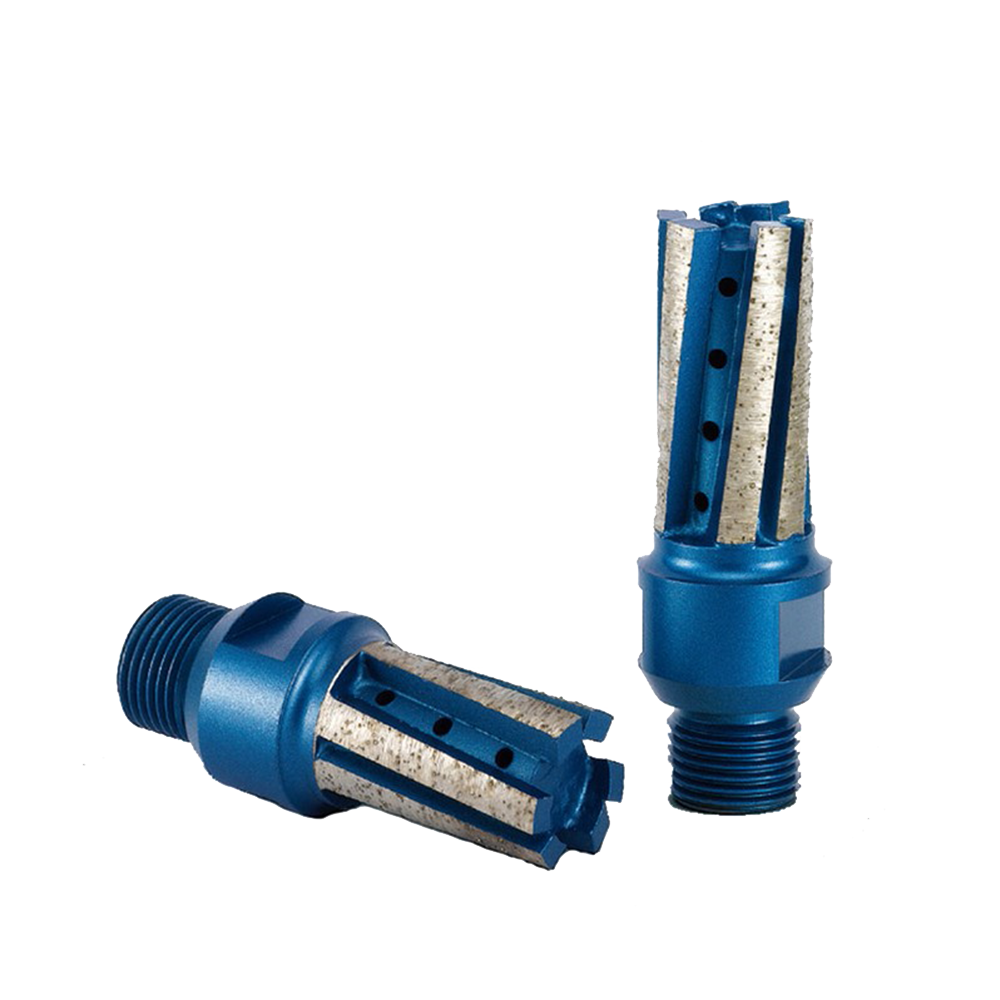
A Finger Bit Is a Finishing Tool, Not a Drill
This is the single most useful thing to understand about finger bits, and the reason most shops own both types:
- Core bits make holes. A core bit drills a round opening quickly — it is a roughing tool, and a fast one.
- Finger bits make holes right. They bring an opening to final size, improve roundness, square up slots, form internal radii and remove the saw or drill marks left behind.
- The usual sequence is: core drill first, finger bit second. Rough the corners with a core bit, then finish to dimension with the finger bit. Forcing a drill to do finishing work is slow and is a common cause of breakout.
The corner radius is decided by the bit — not by the drawing
A finger bit is cylindrical, so it cannot cut a sharp 90° inside corner. Whatever diameter you run, the corner it leaves has a radius equal to half that diameter:
| Bit diameter | Corner radius left | Typical use |
|---|---|---|
| Ø10 mm | R5 | Tight corners, small openings, fine control |
| Ø16 mm | R8 | Small radii, detailed work |
| Ø20 mm | R10 | Standard sink cut-out corner |
| Ø25 mm | R12.5 | Larger openings, faster removal |
| Ø30–50 mm | R15–R25 | Big openings, heavy stock removal |
Full Specifications
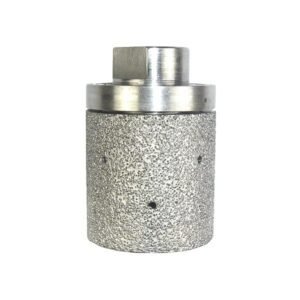
| Product | Diamond Finger Bits (stone milling bits) |
|---|---|
| Function | Enlarging, truing, smoothing, slotting, internal radii, grinding away excess material, pre-polish finishing |
| Abrasive | Synthetic monocrystalline diamond |
| Bond / process | Brazed diamond layer on hardened steel body (electroplated & sintered on request) |
| Head shape | Flat / cylindrical, ball nose (round), cone, chamfer, radius |
| Diameter | 10, 12, 14, 16, 18, 20, 22, 25, 30, 35, 40, 50 mm (custom available) |
| Working length | 15, 20, 30, 40, 50, 60, 80, 100 mm (custom available) |
| Diamond grit | #30/40, #60, #80, #120, #200 |
| Grit class | Coarse #30/40–60 / Medium #80 / Fine #100–200 (pre-polish) |
| Shank / connection | M14, 5/8″-11, 1/2″ Gas (BSP), straight shank 6 / 8 / 10 / 12 mm, 1/4″, 1/2″ |
| Body material | Hardened 45# / alloy steel |
| Water feed | Center water-feed hole — delivers coolant to the cutting face |
| Runout | ≤ 0.05 mm — low-chatter design |
| Working condition | Wet recommended; short dry passes acceptable with extraction |
| Spindle speed (CNC) | 4,500–12,000 rpm depending on diameter |
| Step-down per pass (CNC) | 0.5–2 mm typical |
| Feed rate (CNC) | 200–1,000 mm/min — start conservatively, tune by sound |
| Machine | CNC stone router, CNC bridge saw with milling spindle, radial arm machine, hand-held grinder, engraving machine |
| Workpiece materials | Granite, marble, engineered quartz, quartzite, artificial stone, limestone, travertine, ceramics, concrete |
| Applications | Sink & cooktop cut-outs, faucet and tap holes, soap dispenser holes, blind holes, slots, internal radii, saw-mark removal, pre-polish finishing |
| Finish capability | Can be followed by polishing heads for a finished internal edge |
| Packaging | Individual plastic box / blister, export carton, pallet |
| MOQ | 20 pcs (standard sizes) |
| Lead time | 5–10 days stock; 15–30 days custom |
| Certification | ISO 9001 (CE / EN 13236 on request) |
| HS code | 8207.50.90 |
| Brand | GUSHI |
| Origin | Zhejiang, China |
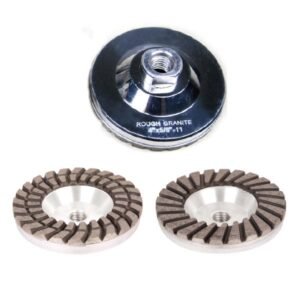
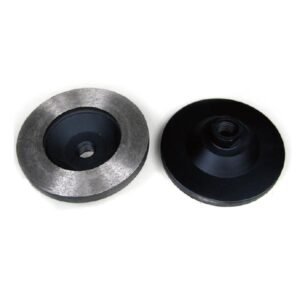
Finger Bit vs Core Bit vs Drum Wheel
Three tools, three jobs. Getting the order wrong is the usual reason a cut-out takes twice as long as it should.
| Dimension | Finger Bit (this) | Core Bit | Drum Wheel |
|---|---|---|---|
| Primary job | Finishing: final size, roundness, radii | Roughing: creating the hole | Blending & final polish |
| Cuts its own entry | Yes (plunge & side-mill) | Fastest | No — follows existing geometry |
| Slot & internal radius work | Yes — any path | No — round only | Limited |
| Removes saw / drill marks | Yes | No | Yes, but only superficially |
| Dimensional accuracy | Highest | Medium | Low — it follows what is there |
| Surface finish left | Medium — pre-polish | Rough | Smoothest |
| Where it sits in the sequence | Second | First | Last |
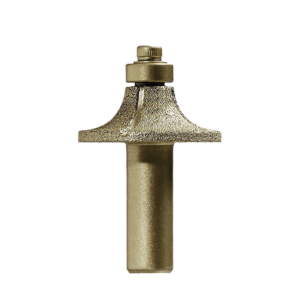
Head Shape: Flat, Ball, Cone or Chamfer
| Head shape | Best for | Note |
|---|---|---|
| Flat / cylindrical | Slots, squaring openings, levelling a bottom face | The default — most rigid, most predictable |
| Ball nose (round) | Contoured carving, 3D relief, soft transitions | Leaves a rounded bottom in grooves |
| Cone | Engraving, bevelling, reaching into tight corners | Smaller tip = slower removal |
| Chamfer / 45° | Arrissing holes, breaking edges on cut-outs | One-pass edge finish |
| Radius (profiled) | Forming a repeatable concave or convex profile | Made to your profile drawing |
Selection Guide
Diameter by job
| Diameter range | Best for |
|---|---|
| Ø10–14 mm | Tight internal corners, small openings, fine control, least load on the spindle |
| Ø16–25 mm | General-purpose countertop cut-outs and hole enlarging — the shop default |
| Ø30–50 mm | Faster stock removal in larger openings, thicker slabs, production work |
Working length by material thickness
| Job | Working length |
|---|---|
| Standard countertop 20–30 mm | 15–30 mm |
| Thick slab or deep internal pocket | 40–60 mm |
| Tall work, special jigs | 80–100 mm |
Grit by material
| Material | Grit | Note |
|---|---|---|
| Hard granite, quartzite | #30/40 – #60 | Aggressive; needs coolant |
| Engineered quartz | #60 – #80 | Balanced; avoids excess chipping |
| Marble, limestone, travertine | #80 | Softer stone — coarse grit is unnecessary |
| Pre-polish finishing | #120 – #200 | Leaves a surface ready for polishing heads |
Sink Cut-Out — The Working Sequence
- Layout and tape. Mark the opening, then apply masking tape over the cut line on the polished face. It stops the bit skating at entry and protects the finish.
- Rough the corners. Plunge a core bit — or the finger bit itself — at each corner. Relieving the corners takes the plunge load off the finger bit for the rest of the job.
- Cut the straight runs. Saw or mill the long sides, leaving 1–2 mm of stock standing proud.
- Mill to final size in shallow passes. Trace the outline with the finger bit, stepping down 0.5–2 mm per pass rather than plunging deep in one go. Keep the center water feed running.
- Let the corners be corners. Remember the radius equals half the bit diameter — Ø20 gives R10. Switch to a smaller bit only if the template demands a tighter radius.
- Finish the internal edge. Move up to a fine grit (#120–#200) or a polishing head to bring the inside edge to the required finish, then arris the top edge lightly.
Keeping Chatter Out of the Cut
Runout is not just noise. A bit that does not run true cuts with one side of the diamond, rounds corners unevenly, chips the arris and wears out long before it should. Four things control it:
- Grip deep. Seat the shank at least three times its diameter into the collet, and make sure the collet is clean and not worn.
- Use the shortest working length that clears the job. Every extra millimetre of overhang is more deflection.
- Keep the shank clean and undamaged. Dried slurry or a nick in the shank will throw the bit off centre no matter how good the collet is.
- Cut shallower. Heavy step-downs are the most common cause of chatter on a setup that is otherwise fine.
Applications
- Undermount and drop-in sink cut-outs in granite, marble and quartz.
- Cooktop and hob openings, plus corner radii to match the appliance template.
- Faucet, tap and soap dispenser holes — enlarging and truing undersized bores.
- Blind holes and recesses, anchor pockets, drainage slots.
- Removing saw marks, truing edges and levelling excess material on thick build-ups.
- Lettering, relief carving and free-form shaping on monuments and feature stone.
- Ceramic and porcelain work where a clean, chip-free opening is required.
Related stone tools: Diamond Router Bits, Brazed Profile Router Bits, Diamond Sanding Sheets, Resin Fickert.
OEM & Wholesale
GUSHI supplies diamond finger bits to countertop fabricators, stone CNC shops, monument makers and tool distributors worldwide. We build custom diameters, working lengths, head shapes (flat, ball, cone, chamfer, profiled), shanks (M14, 5/8″-11, 1/2″ Gas, straight) and grits, and support OEM/ODM and private label. Samples are available for testing; the sample fee is returned against your first official order.
Frequently Asked Questions
Finger bit or core bit?
Core bits make holes fast and are roughing tools. Finger bits finish: final size, roundness, slots, radii and removing saw or drill marks. Most shops core drill first, then finish with a finger bit.
Can it cut a sharp 90° inside corner?
No — a cylindrical bit always leaves a radius equal to half its diameter (Ø20 leaves R10). Design the radius in, square the corner by hand, or use a smaller diameter bit.
What diameter should I use?
Ø10–14 mm for tight corners and fine control, Ø16–25 mm for general cut-outs and enlarging, Ø30–50 mm for fast removal in big openings. Keep diameter at or below twice your target inside radius.
What working length?
Cover thickness plus clearance and no more: 15–30 mm for 20–30 mm countertops, 40–60 mm for thick slabs or deep pockets, 80–100 mm for tall work. Excess length means deflection and chatter.
Speed and depth per pass?
Roughly 4,500–12,000 rpm by diameter on CNC, with 0.5–2 mm step-downs and steady coolant. If edges stay clean, raise feed before raising depth of cut.
Wet or dry — and does the center water hole matter?
Wet, and yes. Center feed puts water at the cutting face instead of somewhere near it, which cools the diamond, flushes slurry and extends life considerably. Dry only for short work with extraction and respiratory protection.
How do I stop chatter and runout?
Grip at least 3× shank diameter in a clean collet, use the shortest working length that works, keep the shank clean and nick-free, and take shallower passes.
MOQ, lead time, OEM, samples?
MOQ 20 pcs standard; 5–10 days stock, 15–30 days custom. OEM/ODM and private label welcome; samples available with the fee returned on your first order.