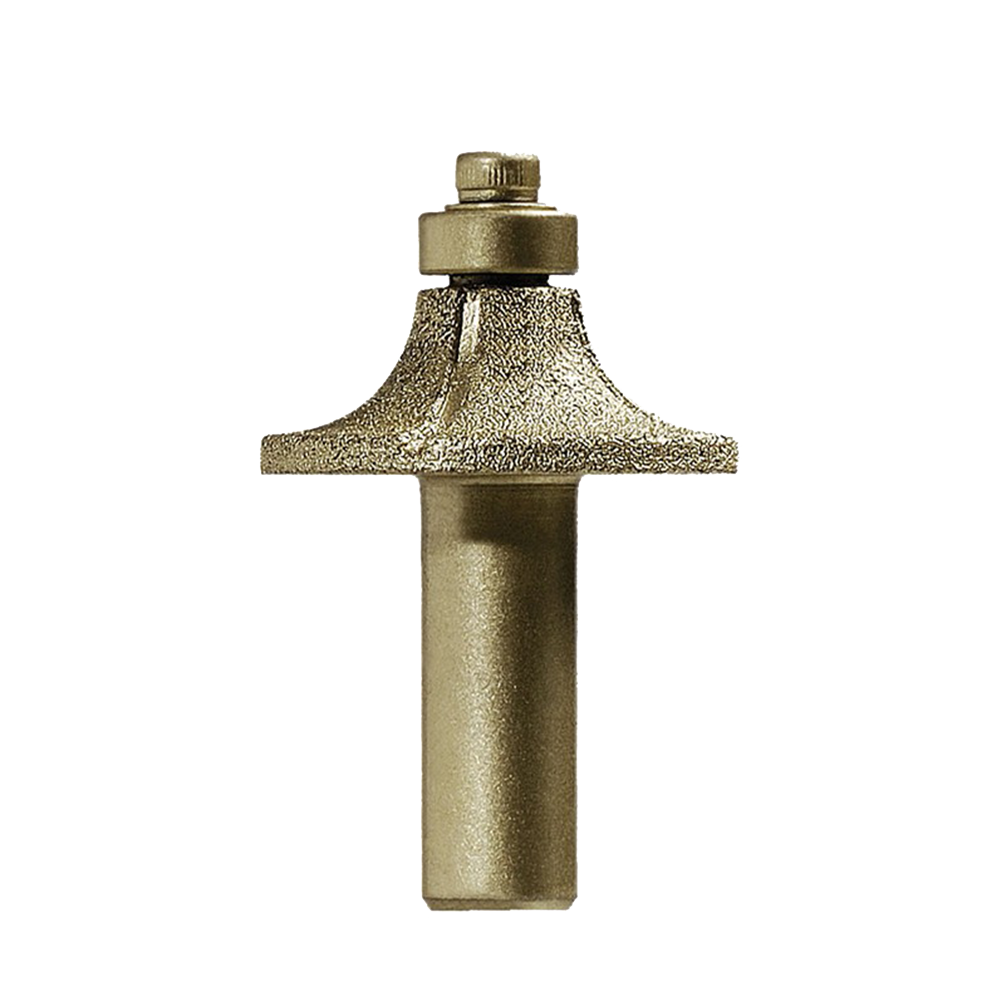
What the Bottom Stop Bearing Does
Most profiling bits have nothing to stop them going deeper than intended. Feed pressure, a soft spot in the stone, or a moment’s inattention and the cutter digs in — the profile is ruined and, on thin material, the bit can break through. The stop bearing removes that failure mode:
- Depth is mechanical, not a matter of feel. The bearing rolls on the slab face (or on a template) and limits how far the diamond can plunge. Skill and consistency stop being variables.
- Repeatability across a batch. Ten vanity tops profiled on different days by different operators come out the same, because every pass references the same face instead of the operator’s judgement.
- Protects the underside. On eased and bevelled edges especially, the bearing prevents the cutter from running past the profile and scoring beneath the slab.
- Acts as a template follower. Run the bearing against a template or a straightedge and the bit copies that line — useful for consistent overhangs and for profiling already-installed work.
- It is a wear item, not a liability. The bearing is replaceable. It runs in stone slurry at high rpm and will wear before the diamond does — swap it when it feels rough or stops spinning freely.
Full Specifications
| Product | Brazed Diamond Profile Router Bits with bottom stop bearing |
|---|---|
| Manufacturing process | Brazing — diamond bonded to a hardened steel body under controlled heat |
| Abrasive | Synthetic monocrystalline diamond |
| Standard profiles | Eased, half bullnose, full bullnose, demi-bullnose, ogee, Dupont, 45° bevel, roundover, cove |
| Custom profiles | Made to drawing or to sample edge |
| Diamond grit | #30/40, #60, #80, #100, #120 |
| Grit class | Coarse #30/40–60 / Medium #80 / Fine #100–120 |
| Profile diameter | 20, 25, 30, 40, 50, 60, 70, 75 mm (custom available) |
| Profile height | 15, 20, 25, 30, 35 mm |
| Guide bearing | Bottom stop ball bearing, replaceable — steel standard, nylon-sleeved optional |
| Bearing function | Depth limit and template following; prevents cutting into the stone |
| Shank / connection | M14, 5/8″-11, 1/2″ Gas (BSP), straight shank 6 / 8 / 10 / 12 mm, 1/4″, 1/2″ |
| Body material | Hardened 45# / alloy steel |
| Working condition | Wet recommended; dry acceptable for short intermittent passes |
| Coolant | Water or other coolant — recommended to extend service life |
| Max speed (Ø20–30 mm) | up to 12,000 rpm |
| Max speed (Ø40–50 / Ø60–75 mm) | 8,000–10,000 / 6,000–8,000 rpm |
| Machine | Hand-held stone router, CNC stone router, radial arm machine, angle grinder, edge profiling machine |
| Workpiece materials | Granite, marble, engineered quartz, artificial stone, limestone, travertine, concrete |
| Applications | Countertop and vanity edge profiling, staircase treads, window sills, tombstone edges, coping, decorative mouldings |
| Cut quality | Chip-free profiling with a consistent, repeatable profile line |
| Runout tolerance | ≤ 0.05 mm |
| Colour | Per request |
| Packaging | Individual plastic box / blister, export carton, pallet |
| MOQ | 20 pcs (standard profiles) |
| Lead time | 5–10 days stock; 15–30 days custom profiles |
| Certification | ISO 9001 (CE / EN 13236 on request) |
| HS code | 8207.50.90 (stone) / 8207.70.90 (wood-cutting versions) — confirm with your broker |
| Brand | GUSHI |
| Origin | Zhejiang, China |
Bearing-Guided vs Freehand vs CNC Copy
The same profile can be cut three ways. What changes is how much the result depends on the operator.
| Dimension | Bearing-Guided (this) | Freehand (no bearing) | CNC Copy / Auto-Profiling |
|---|---|---|---|
| Depth control | Mechanical — set by the bearing | Operator feel | Programmed |
| Repeatability piece to piece | Identical | Varies with operator and fatigue | Identical |
| Risk of cutting into the stone | Very low | High | Low |
| Free-form / variable geometry | Low — follows the face | High | Medium |
| Machine cost | Hand router or grinder | Hand router or grinder | CNC machine |
| Setup time | Minutes | Minutes | Programming + proving |
| Best fit | Repeat batches, on-site work | One-off shaping, repairs | High volume, identical parts |
Brazed Diamond vs TCT Carbide vs HSS
Choose the cutter material by what you are cutting — this is the decision that decides whether a bit lasts a day or a season.
| Dimension | Brazed Diamond (this) | TCT Tungsten Carbide | HSS High-Speed Steel |
|---|---|---|---|
| Cuts stone / quartz / concrete | Yes — designed for it | No, destroys the edge in metres | No |
| Cuts wood, MDF, acrylic | Poor choice | Yes — the default choice | Yes, short life |
| Edge life on granite | Longest | Minutes | Seconds |
| Edge quality on stone | Profiled finish ready to polish | Tears and chips | Burns |
| Heat resistance | Highest | Good | Poor |
| Re-sharpenable | No — replace when worn | Yes, several times | Yes |
| Price | Highest | Medium | Lowest |
| Rule of thumb | Stone → diamond | Wood & composites → carbide | Soft wood, tiny budget |
Profile Catalogue & Selection Guide
Standard edge profiles
| Profile | Typical radius / size | Where it is used |
|---|---|---|
| Eased | 2–3 mm arris | Default for quartz and modern kitchens; easiest to keep clean |
| Half bullnose | R = half the slab thickness | Rounded top, square bottom — the most common countertop edge |
| Full bullnose | R = full slab thickness | Fully rounded; classic look, needs full-thickness material |
| Demi-bullnose | R ≈ 3/4 thickness | Rounded with a short straight face below |
| Ogee | Compound S-curve | Traditional, formal kitchens and vanity tops |
| Dupont | Steep bevel into radius | High-end decorative edge |
| 45° bevel / chamfer | 3–20 mm face | Contemporary mitred looks, staircase treads |
| Roundover / cove | R3–R15 | Softer edges, sills, coping, decorative mouldings |
Grit by material and priority
| Material / priority | Recommended grit | Note |
|---|---|---|
| Hard granite — removal rate first | #30/40 or #60 | Fastest; leaves more polishing work |
| Marble, limestone, travertine | #80 | Softer stone — no need for coarse |
| Engineered quartz — chip risk | #100 – #120 | Finer = cleaner edge, fewer rejects |
| Edge finish more important than speed | #100 – #120 | Shorter polishing sequence afterwards |
Speed by profile diameter
| Profile diameter | Max rpm |
|---|---|
| Ø20–30 mm | 12,000 rpm |
| Ø40–50 mm | 8,000–10,000 rpm |
| Ø60–75 mm | 6,000–8,000 rpm |
How to Run — Setup Steps
- Check the bearing first. Spin it with a finger. It must turn freely and smoothly with no grit or roughness. A bearing that skids will tear the stone surface instead of rolling along it.
- Mount and check runout. Seat the shank fully in the collet or thread on hand-tight, then wrench-tight. Confirm the bit runs true before it touches stone.
- Set speed by diameter — never exceed the marked maximum rpm.
- Turn coolant on before contact. Water to the cutting zone, not just a spray in the general direction.
- Let the bearing find the face. Bring the bit in with the bearing already riding the slab or template, then feed along the edge.
- Take the profile in two or three shallow passes rather than one deep one — this is what keeps quartz from chipping at the arris.
- Do not force the feed. Let the diamond cut; pressure overheats the braze layer and loads the bearing.
- Replace the bearing early, replace the bit when glazed. A seizing bearing can ruin a finished face; a glazed or slow-cutting diamond layer means the bit is finished.
Applications
- Kitchen countertop and island edges on granite, marble and engineered quartz.
- Bathroom vanity tops and washbasin surrounds — eased, bullnose and ogee.
- Staircase treads and risers, window sills and threshold profiles.
- Shopfitting and reception counters in artificial stone and solid surface.
- Memorial and monument edging, lettering backgrounds and carved mouldings.
- Concrete coping, pool surrounds and architectural precast edge profiling.
Related stone tools: Diamond Router Bits (finger & sink cut-out), Resin Fickert, Diamond Sanding Sheets, Concrete Floor Polishing Pads.
OEM & Wholesale
GUSHI supplies brazed profile router bits to countertop fabricators, stone workshops, monument makers and tool distributors worldwide. We produce standard profiles from stock and build custom profiles, diameters, shanks (M14, 5/8″-11, 1/2″ Gas, straight) and grits to your drawing or sample. Nylon-sleeved bearings are available for finished-face work. OEM/ODM and private label are welcome; samples can be sent for testing with the sample fee returned against your first official order.
Frequently Asked Questions
What does the bottom stop bearing actually do?
It is a depth limiter and a guide. The bearing rides on the slab face or a template while the diamond above cuts, so the cutter can only remove the profile and no more — it cannot bite deeper into the stone. Every piece comes out identical, and the classic accident of gouging the underside is avoided.
Can the bearing be replaced?
Yes, and it should be. The bearing is a wear item running in slurry at high rpm, so it wears before the diamond. Swap it when it feels rough, rumbles, or stops spinning freely — a seized bearing will burn the stone surface. Nylon-sleeved versions are available for already-polished faces.
Which edge profiles can you make?
Standard: eased, half bullnose, full bullnose, demi-bullnose, ogee, Dupont, 45° bevel, roundover and cove. Because the diamond layer is formed on the shaped steel body, custom profiles can be made to your drawing or a sample edge — 15–30 days for made-to-order work.
Wet or dry?
Both are possible, but wet is strongly recommended. Coolant protects the braze layer, flushes slurry away from the bearing and controls silica dust. Dry running is acceptable only for short intermittent passes with extraction and respiratory protection.
Brazed diamond, TCT carbide or HSS?
Match the cutter to the material. Diamond for granite, marble, quartz, artificial stone and concrete. TCT carbide for wood, MDF, plywood and acrylic. HSS only for soft wood and very small budgets. A carbide bit on granite is destroyed within metres.
Which grit should I choose?
#30/40 or #60 for fast removal on hard granite, #80 for general profiling on marble and engineered stone, #100–#120 when finish quality matters more than speed or when the quartz is chip-prone.
How do I stop the edge chipping out?
Finer grit on the final pass, several shallow passes instead of one deep one, steady coolant, no forced feed, full support along the slab, and a bearing that rolls smoothly rather than skidding.
MOQ, lead time, OEM, samples?
MOQ 20 pcs for standard profiles; 5–10 days from stock, 15–30 days for custom profiles after deposit. OEM/ODM and private label welcome; samples available with the fee returned on your first order.