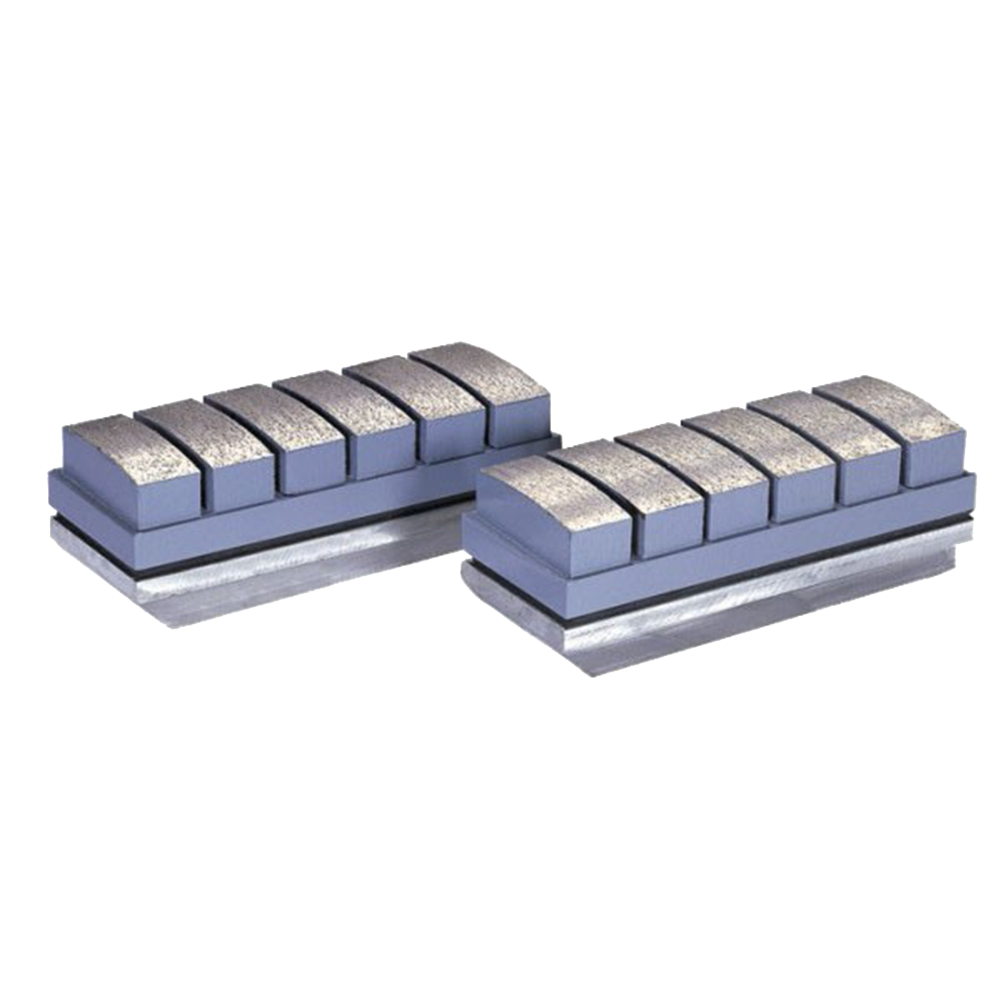
Where the Resin Fickert Sits on the Line
A polishing line is a sequence of grits, and each bond type owns a phase:
- Metal-bond Fickert (#36–#120) — opens the slab, flattens, longest life but coarser and hotter.
- Resin-bond Fickert (#120–#1500) — this product. Faster cutting, finer scratches, cooler; carries the slab to near-mirror.
- Buff / felt (#1500 + buff) — final gloss pass, no abrasive cutting.
Resin is the workhorse of the line: it removes the most visible scratches and sets the gloss the buff stage only enhances.
Full Specifications
| Product | Resin-Bonded Diamond Fickert (Resin Fickets) |
|---|---|
| Abrasive | Diamond micro-powder (some grades SiC micro-powder) + resin bond |
| Bond | Modified high-temperature phenolic resin, fiberglass-reinforced |
| Type / shape | A, B, XT (trapezoid); T-140, T-170 |
| Length (L) | 140 mm, 170 mm (custom available) |
| Width | 50, 56, 60, 70 mm |
| Height | 70–95 mm (segment height 12–20 mm typical) |
| Base | Bakelite (phenolic) mounting base; screws/clips to polishing head |
| Grit range | #36 #46 #60 #80 / #120 #180 #220 #240 #280 #320 / #400 #600 #800 / #1200 #1500 #3000 / buff |
| Grit class | Coarse #36–80 / Medium #120–320 / Fine #400–800 / Polish #1200–3000 |
| Working condition | Wet (continuous water cooling) |
| Machine | Automatic / semi-automatic granite polishing lines, beveling polishers |
| Application | Granite, marble, ceramic tile slabs — middle-fine grinding & polishing |
| Phase on line | Middle phase, before final buffing/felt |
| vs metal bond | Faster cutting, cooler, finer scratch; wears quicker, less form-holding |
| Formula by stone hardness | Yes — bond & concentration matched to granite/marble hardness |
| Lifespan | 2,000–3,000 m² (#60–320); 6,000–8,000 m² (#400–1500) |
| Gloss result | ≥ 85° mirror at #1500 (before buff) |
| Eco vs magnesite | ~20% less cost, ~50% less electricity, +10–15° gloss, ~400× less dust |
| Color | Per request |
| Package | 24 / 30 pcs per carton |
| MOQ | 24 pcs (standard sizes) |
| Lead time | 5–10 days stock; 15–30 days custom |
| Certification | ISO 9001 |
| HS code | 6804.22.90 |
| Brand | GUSHI |
| Origin | Zhejiang, China |
Resin Fickert vs Metal-Bond Fickert
Both mount on the same head and both carry diamond — the difference is the bond, and that decides which phase each owns.
| Dimension | Resin Fickert (this) | Metal-Bond Fickert |
|---|---|---|
| Best phase | Middle–fine (#120–#1500) | Rough flattening (#36–#120) |
| Cutting speed | Faster | Slower |
| Scratch fineness | Finer | Coarser |
| Heat | Cooler | Hotter |
| Wear / life | Wears quicker | Longest |
| Form holding | Less | Best |
| Cost per m² | Lower (less electricity) | Higher |
| Use on line | Carries slab to buff | Opens the slab |
Resin Fickert vs Magnesite Block vs Floor Pad
| Dimension | Resin Fickert (this) | Magnesite Block | Floor Polishing Pad |
|---|---|---|---|
| Machine | Auto/semi-auto line | Auto line (old) | Planetary floor grinder |
| Material | Granite / marble / tile | Granite / marble | Concrete / terrazzo |
| Grinding cost | ~20% less | Baseline | n/a (different job) |
| Electricity | ~50% less | Baseline | — |
| Gloss gain | +10–15° | Baseline | — |
| Dust | ~400× less | High | Low (with vacuum) |
| Breakage | Tough, fiberglass | Brittle | Flexible |
Selection Guide
Grit sequence on the line
| Phase | Grits (typical) | Block type |
|---|---|---|
| Open / flatten | #36 → #60 | Metal bond |
| Middle | #120 → #220 → #400 | Resin (this) |
| Fine | #800 → #1200 → #1500 | Resin (this) |
| Mirror | buff / felt | Buff |
Match the formula to the stone
- Hard granite (black / absolute) → more aggressive resin, coarser diamond, higher concentration — needs cutting power.
- Soft granite / white marble → finer, cooler resin — avoids burning and orange-peel.
- Ceramic / porcelain tile → medium resin, consistent water flow to clear the fine slurry.
- Tell us the slab type when ordering so the bond and concentration are set correctly.
How to Run — Line Setup Steps
- Mount the block on the head with the correct base; confirm length (T-140 / T-170) matches the head.
- Start water first. Continuous flow must run before the head touches the slab — resin runs wet only.
- Set the sequence #36→#60 (metal) then #120–#1500 (resin) then buff; two cross-hatch passes per grit.
- Rinse between grits to avoid carrying coarse slurry onto fine heads.
- Check gloss at #1500 — target ≥ 85° before buff.
- Replace when cutting slows or gloss drops; track m² per block to tune the formula.
Applications
- Granite slab polishing on 16/20-head automatic lines.
- Marble and engineered-stone slab middle-fine phase.
- Ceramic / porcelain tile surface refining.
- Bevel and edge polishing on beveling polishers.
- Replacing magnesite blocks for lower cost and cleaner workshops.
Related stone & superabrasive tools: Concrete Floor Polishing Pads, Diamond Sanding Sheets, Resin Bonded CBN Grinding Wheels.
OEM & Wholesale
GUSHI supplies resin Fickert blocks to stone-processing plants and distributors worldwide. We set the bond and diamond concentration by your slab type, support OEM/ODM and private label, and make custom lengths (T-140 / T-170), grits and bases. Samples are available for line testing; the sample fee is returned against your first official order.
Frequently Asked Questions
Resin vs metal Fickert — when?
Metal for rough flattening (#36–#120, longest life, holds form); resin for middle-fine (#120–#1500, faster, cooler, finer). Metal opens, resin carries to buff.
What machine — hand grinder?
Fickert mounts on automatic/semi-auto line heads (and bevelers). Not for angle grinders — those use Frankfurt abrasives or Velcro pads. Match length/base to your head.
Grit sequence on the line?
#36→#60 (metal) → #120→#220→#400 (resin) → #800→#1200→#1500 (resin) → buff. Resin covers ~#120–#1500. Never skip a grit.
Hard vs soft granite formula?
Hard granite → aggressive resin + coarser diamond; soft/white → finer, cooler resin to avoid burning. We set bond by stone hardness — tell us the slab type.
Wet only?
Yes. Continuous water cools the resin and flushes slurry; dry running scorches the slab and destroys the block.
Lifespan per block?
#60–#320 covers ~2,000–3,000 m²; #400–#1500 covers ~6,000–8,000 m². Varies with stone, pressure and water flow.
Why over magnesite?
~20% lower grinding cost, ~50% less electricity, +10–15° gloss, ~400× less dust, and no brittle breakage.
MOQ, lead time, OEM, samples?
MOQ 24 pcs standard; 5–10 days stock, 15–30 days custom. OEM/ODM welcome; samples available with fee returned on first order.